Monday, February 1, 2010

What is Organic Milk, and Why Should You Care?

I've been following Ruth Reichel on Twitter for a while since I heard her speak about the demise of Gourmet Magazine, the incredible work done there during her tenure as Editor in Chief, and her thoughts on the future of food, food writing and food politics. Today, her feed led me to a great blog, Politics Of  The Plate. Food politics is definitely something that I have been thinking about for a while.  Where does our food come from?  Who makes it?  How is it made?  Is it safe?  Is it ethically produced, and what does that mean?  As the world's population grows and resources remain finate (or until we figure out how to make that Star Trek Food Replicator), I believe that these issues will remain with us, and become more and more important.

Anyway, the January 27 post on Politics of the Plate is about how big Agribusiness has taken control of the word organic. In theory, organic milk comes from cows who have "room to roam, clean air to breathe [and] fresh grass to eat."  Makes sense.  Unfortunately, the same way that most "free range" chickens probably don't have the opportunity to visit the small outdoor pen attached to the side of their giant, packed, indoor jail instead of roaming freely, pecking at grubs and enjoying sunshine on their feathers, many "organic" milk cows don't really have access to pasture in the traditional sense.  They might be outdoors, but they are probably walking around in dirt, not pasture land.  They might be eating grass, if you consider dried fodder as grass-like.  (There is one dairy that claims pastureland by laying hay on the dirt on a strip of land outside their giant barn)  They might be organic in the sense that they aren't pumped through with chemicals, but there is no way that they are the happy cows taking time to chew their cud while enjoying  a little clover, alfalfa and dandelion as part of their nutritious grass lunch we all dream of when we bite into a delicious piece of Avonlea Cheddar.

There are a few problems here that I can see (beyond the fact that it just isn't very nice to the animals!).   When big dairies are allowed to blur the lines regarding what constitutes "pastureland," dedicated family farms that have invested in their "staff" of cows and really believe and follow the tenants of organic farming just can't compete.  The cost of raising a truly happy organic cow on green pastures is astronomical compared with the cost of cows that might or might not get to go outside, and might or might not actually get to eat real grass every day.  Plus, the little guy might have 80 cows and the big guy has 2,000.  Economies of scale just don't tip in favor of the little guy.  I'm like you.  I'd love to buy the organic milk at the farmer's market, but man-o-man is it expensive.  I feel like I'm still being healthy if I'm buying Horizon brand organic milk on sale.  Problem is, buying like that is making the problem worse.  (And depending on why you are buying organic milk, you might be getting ripped off!)   (dairy image courtesy of Wikipedia)

Problem number two is an issue of taste!  I'm always writing about how I can taste the spring grass freshness in a cheese.  You can't get that if the cows don't actually eat fresh spring grass on a hillside somewhere.  If big agribusiness manages to shut down more and more small truly organic dairies, there will be less and less delicious milk lightly scented with daisies to make amazing cheese.  And that would really be a crying shame.

Anyway, there is a bill before the federal Office of Management and Budget to make the rules more specific regarding what is considered organic.  Needless to say, the big guys want to kill the bill to make a buck. Politics being what they are, who knows what will happen.  If you have time, definitely visit Politics of the Plate to learn more about what is going on, and get links to more great information.

And thanks for listening.

Friday, January 29, 2010

Pt. Reyes Farmstead Cheese Company - The Blues are going Green!

I picked up some Pt. Reyes blue at the grocery store last summer, and it created a creamy, salty, pungent base for a delicious steak salad.  It was one of the first blues I sampled as an official cheese head, and it definitely created the impetus for me to go out and boldly try all kinds of blue cheese.  Since then, I've introduced y'all to many of the stars in a world where the moon is, in fact made of blue cheese.

With my new Friday series highlighting some of my favorite cheesemakers (and my incredibly dull Wednesday night class allowing me time to do the internet research that I need...), I've started cruising the state cheesemaker organization websites.  Since I'm a Cali girl (omigod!  fer sher!), I've started at the California Artisan Cheese Guild.  They have a great list of California dairies, and a map of where all of these good people live, work, and care for the beasties that provide the raw materials for our favorite food.  Sadly for me, almost all of these guys live in Northern California, while I alternately bake and drown in Los Angeles.

So anyway - Pt. Reyes Farmstead Cheese Company.  The Giacomini family has owned and operated this dairy, milking cows since 1959 and started making cheese in 2000.  The ranch is located on the hills overlooking Tomales Bay in Marin County.  These are the epitome of happy California cows!  They've got a beautiful view.  It never gets too hot.  Their tasty grass is nicely salted by the morning dew coming off the bay.  You can taste all this joy in every crumble.

The Giacomini's have always been focused on their all natural production, but according to the "fun facts" section of the Artisan Cheese Guild, they have taken it to a whole new level.  And I quote, "Original Blue Cheese is now Green!  (Oh no, I thought for a split second!)  The production facility is fuled entirely by the methane gas that rises from the farm's collected cow's manure - delivering on the Giacomini's commitment to sustainability."   I'm not sure if they are totally off the grid yet like the Lazy Lady, but what a great start.  


I'd love to see that facility!  I'm imagining a giant pile of poo in a storage room with some pipes in the ceiling and a bunch of fans directing the stinky air into a processing room where the lights shine bright, and the workers are always smiling (because of their awesome personal ventilators!).  Must do more research.  Especially with the concerns about greenhouse gasses and global warming, the fact that these guys are helping protect their little corner of paradise.


Here's to the happy cows at Pt. Reyes Farmstead Cheese Company and their very clever keepers!  Way to go Bessie!  Keep it up!

Wednesday, January 27, 2010

Cheese for a Wednesday, pt. 20 - Pirate Edition


Yarg!  A basic of pirate vocabulary is also the name of a great cheese from Cornwall.  A really beautiful, special cheese, this cow's milk beauty is an updated version of a 13th century recipe.  A cross between Welsh Caerphilly and English Wensleydale, Yarg is actually named for Mr. Alan Gray, the cheesemaker responsible for developing the modern recipe in 1984.  (Get it?  Yarg/Gray...those Brits are soooo clever!)

When I went into Andrew's Cheese Shop last week to announce my desire to bring back Welsh Rabbit, Andrew offered up Cornish Yarg, made in Cornwall, just south of Wales.  While we ultimately decided it wouldn't necessarily be good melted with beer, even if it was practically Welsh,  it is a great English cheese. At first sniff, you really smell the milky freshness of this cheese.  Then you realize how sweet and "green" it smells.  The green comes from a unique ingredient in this cheese - the Stinging Nettles it is wrapped in!  The good news is that the leaves are frozen to get rid of the "stinging," but there is definitely a tangy flavor that can be attributed to this natural rind. I did  eat the nettle rind, and it really did add extra depth to the cheese.  And it's so pretty!  Whole wheels make an amazing bottom layer of a cheese "cake."

The texture is both crumbly and a bit sticky.  Oxymoronic, perhaps, but it's true.  The flavor is very smooth, with a bit of tart on the middle of your tongue.  The milk that you smell is the dominant flavor of this cheeseThere is a bit of moldiness, and a little (tiny bit of) mushroomy flavor, but that just adds to the old fashioned flavor of this cheese.  And when you realize the original recipe is 700+ years old, that makes sense!

Cornish Yarg is only made at one dairy in Cornwall, but it's made its way around the world.  It's also a great thing to put on the "bucket list" if getting to Cornwall is on your list.

Or if you want to be a pirate...Yarg!

Tuesday, January 26, 2010

And Now for Something Completely Different...

*Apologies for no photos, but please, please, please click the links. They are hilarious!

Saturday night, I found myself in a dark basement sitting on an uncomfortable chair, laughing my a@% off.  Darling Husband and I had gone out to meet some friends and enjoy an evening of twisted drag queen frivolity.  We knew it was going to be a great night when Dina Martina's first song was the most ridiculous version of Duran Duran's Rio that I had ever heard.  At one point, she sang something about Rio being one of the longest songs ever (which it is, really...), after which she proceeded to eat a plate of spaghetti with Ragu and some Kraft Parmesean cheese (the kind in the cardboard tube).  A girl after my own heart - while waiting for Simon LeBon to finish singing something about the dusty land, Ms. Dina dumped a good 1/4 cup of powdered cheese right in her mouth, not needing spaghetti or sauce to sully the flavor of, well, whatever it is that that "cheese" tastes like.

I wasn't expecting cheese references in my evening of surreal, gender bending humor, but was certainly delighted!  There were several others throughout the night.  I think I'll save her story of her grandmother surviving the depression by milking the family pug and making delicious pug's milk cheese for another time - I want to look into the feasibility of this in the real world (I doubt that dog's milk has quite the level of butterfat necessary to make quality cheese, but...hey - it was the Great Depression!  Never mind the fact that the idea of milking a dog just seems a bit odd to me.  You?)

No, neither the spaghetti interlude at nor the story of how Pugsley saved the family compare to what happened during gift time.  An unsuspecting audience member bravely stepped onstage.  "Do you like cheese?"  Ms. Dina asked.  Of course, the answer was "Yes."  "Do you have chapped lips?" was the odd follow-up question.  The answer there was also "Yes."  Can you guess what product contains cheese and is good for your lips?

My answer would be a nice, oily Manchego or Zamorano sheep's milk cheese.  But I would be wrong.

What Ms. Dina pulled out of the bag for this nice audience member was...


CHEETO LIP BALM!!!!!

Discuss.

Friday, January 22, 2010

Welsh Rabbit - Friday update


It kept raining today.  Then it started to hail.  HAIL!  In Los Angeles.  Armageddon is right around the corner.  

Since yesterday's post about the legends of Welsh Rabbit, I got a hankering.  Plus, I felt guilty writing about something that I hadn't recently eaten or made.  So, off I headed to Andrew's Cheese Shop when the bell rang at the office for a high quality cheddar and a little inspiration.  He was a bit surprised that I was making Welsh Rabbit.  Why?  I said.  Turns out, in his opinion people don't make it any more.  I suggested that he re-introduce it during one of his Grilled Cheese nights, where he pairs all sorts of grilled cheese with all sorts of beers.  It's perfect - cheese and beer in one bite.  He said he'd think about it.  We'll see...

So, updates to the recipie posted last night...
#1 - Be careful when grating your cheese!  I cannot emphasize enough how much you do not want grated fingernail and thumb in your dinner!  I managed to avoid any thumb, but there might have been some fingernail.  Patience people!  It will all get done, and in less than 20 minutes start to finish.
#2 - I don't actually have anything bad to say about 2 Tablespoons of butter.  I just wanted to show you my cute cow butter holder.  It's one of the few things I've managed to hang onto since my early bachelorette days.  Moo.
#3 - Flavoring and texture.  You might be better off with just 2 Tablespoons of flour.  Three Tablespoons make for a really, really thick sauce (and probably precipitated the need for more beer.  See #4)  Also, I tasted a little more mustard than I would have liked in the final product.  Maybe reduce dried mustard to  1/4 teaspoon and increase the Worcestershire sauce to 2 1/2 tablespoons.  But, perhaps that's just me.
#4 - I found that there was no way that 1/2 cup of beer was going to be enough to give the cheese sauce enough fluidity to spread over our extra thick sliced toast.  I added another 1/4 cup, and then another 1/4 cup.  So, in the end, about one cup  of beer seemed to do the trick.  We used a great British dark ale, courtesy of Andrew's newly instated liquor sales license.  Yay Andrew!  Even with the cup in the sauce, there was enough left over for us to each enjoy a small glass of this rich, hoppy, brew with just a hint of sweetness.  I wish I had a better taste vocabulary for beer.  In any case, it was really good.
#5 - Try to find a nice loaf of bread, and slice it yourself.  Darling Husband was in charge of slicing, and he went with one inch slices.  Toasted to crispy but not too dark it served as the perfect platform.

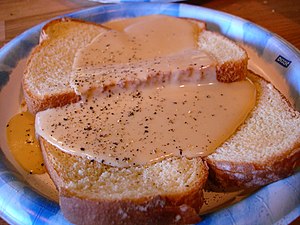
At the end of the day, Darling Husband and I enjoyed a great dinner of cheese, bread and beer.  A perfect food.  And - to add to the success, DH remembered the smell and taste of our concoction from his childhood when his dad (the Scot) would whip up a batch of this easy, cheap (well, not so cheap with fancy imported beer and cheese, but you get the idea) snack.  When you can tap into someone's olfactory memory, I'd say that's a job well done.  Look at that gooey goodness!  What's weird is that the flavors of Worcestershire, beer and mustard blend so well with the cheese that what you have at the end is an all new flavor.   I'm still working on what the profile is, but it is rich.  The mustard is crucial to keeping it from tasting flabby, and the Worcestershire adds it's magical blend of herbs and spices to make this cheese sauce so much more.  Who needs rabbit (or filet mignon for that matter) when you have cheese and bread?

I had bought some broccoli, but somehow it never made the steamer...

Welsh Rabbit - all the cheese, none of the bunny fur!


The rain is still coming down in Los Angeles, and my poor dog is terrified of thunder and wind - both of which we seem to have an endless supply of at the moment.  Did you hear we've had tornados?  Time for comfort food.

To mix things up a little, how about Welsh Rabbit?  Also known as Welsh Rarebit, it's basically cheese sauce on toast, but it's so much more!  There are many legends associated with this simple fare.  1) When my mom used to make it when I was a kid, I just thought that we were eating the vegetarian version, and that the glamorous Welsh used to have chunks of rabbit in their cheese sauce.  2) According to Mick, the British proprietor of our favorite local cafe, the name is a total slur on the Welsh, who the English perceive as inferior due to their coal mines and propensity for words with too many w's, and y's (see Aberystwyth).  His version contends that the Welsh were so poor, that they couldn't even afford rabbit - which used to be one of the cheapest proteins available.  They were so poor, they could only afford cheese and bread.  3) Another version says that Welsh rabbit hunters, after a successful rabbit hunt, would eat this fortified cheese toast upon returning home - thereby negating Mick's version of the legend.  4) Of course, there is another version where unsuccessful Welsh rabbit hunters have to eat cheese toast because they aren't very good hunters.  5) A really twisted version claims that a Welsh chef tried to pass off cheese toast as rabbit to unsophisticated Welsh diners.  While I have actually never eaten rabbit, I might argue that melty cheese toast is easier to prepare and perhaps tastier than rabbit.  Also, since Darling Husband is 50% Welsh, I'm not allowed to be to antagonistic toward  this noble people.

Legend aside, it is a perfect meal for a cold winter night.  Here's a recipe for Welsh Rabbit from Laura Werlin's fantastic book The New American Cheese:

Melt 2 Tbsp butter over medium heat in a medium size saucepan.
Add 3 Tbsp flour and stir for 1 minute
Add 1/2 cup beer and stir until the bubbles start to cook out, about 30 seconds
     (I would suggest a more flavorful, darker beer.  Alternately, my mom used milk.  Less body, but better for kids...)
Add 6-7 ounces of grated cheddar cheese, 2 tsp Worcestershire, 1/2 tsp dry mustard and a dash of cayenne.


Stir constantly until the cheese melts.

Toast up 4 thick slices of substantial bread (Wonderbread will not work!)

Toast on plate, cheese sauce on toast.  If you're trying to eat veggies with all your meals, add a tomato.

*You can always try other cheeses - whatever you have.  Try Gouda or Emmenthaler for some happy melting.  A little fortified Sherry could be tasty too.  If you use white cheese, a little Paprika would add color. a tablespoon of Dijon mustard could be a nice alternate if you don't have any dry mustard in the house.

That's it!  Easy enough for a Welshman to do it.

Sweet dreams!  May your dreams be full of cheese and sweet bouncing bunnies!

Wednesday, January 20, 2010

National Cheese Lover's Day!


Apologies for the late notice, but I was just informed of this most joyous of occassions!  I can't believe we don't get the day off for this...it is officially National Cheese Lover's Day!

Not sure why, not sure how, not sure if in fact it has been ratified by congress or just a marketing ploy, but I don't care!  Here's to you cheese lovers!